
Understanding fairway mowing patterns in golf course maintenance
Fairway mowing patterns have long been an iconic feature of golf courses. From subtle striping to intricate, high-contrast designs, these patterns are used to shape not only how a course looks, but how it plays and how it is perceived by members and visitors alike.

For course managers, however, mowing patterns influence more than playability and aesthetic considerations: they must also reflect a delicate balance between operational efficiency and long-term turf health.
In this guide, we explore what fairway mowing patterns are, why they matter and how modern equipment is giving courses more flexibility than ever before.
What are fairway mowing patterns?
Fairway patterns are the visible designs achieved through a combination of mowing direction, light reflection and the striping effect created by rollers or cutting units. When grass is mowed and bent in the same direction, it reflects light differently than the areas where grass blades are bent the opposite way, producing a characteristic light and dark contrast.
At a basic level, patterns can be simple, but on many modern courses, they are used more creatively to influence:
- Perceived width and shape of a fairway: making holes look wider, narrower or more strategic.
- Course character and aesthetics: from traditional and understated to bold, intricate designs.
- Strategy and play: the average perception among golfers is that when grass is mowed against the direction of play it will reduce roll, and vice versa.

While complex patterns are often associated with top-tier venues, they are increasingly seen across a wide range of courses, as expectations around presentation continue to rise.
Understanding fairway fashion: classic cuts and styles
As mowing patterns evolved over time, a shared language has emerged within the industry, sometimes referred to as fairway fashion. Let’s examine some of the most common styles and considerations for each different approach.
Half and half
As the name suggests, the half and half or 50/50 pattern splits the fairway into two contrasting halves, typically light on one side and dark on the other.

Why courses choose it
- Simple but effective visual contrast
- Helps define strategy and alignment from the tee
- Easier to maintain than more complex patterns
Considerations
- Less visually intricate than other styles
- Still requires consistent directional control
Light and dark striping
Together with the 50/50, this is the most traditional and widely used mowing pattern, consisting of alternating light and dark stripes running along or across the fairway.

Why courses choose it
- Clean, consistent and highly recognisable
- Efficient to implement across large areas
- Suitable for a wide range of course styles
Considerations
- Needs regular variation in mowing direction to avoid turf stress
- Can appear less distinctive compared to more modern styles
Diagonal or diamond pattern
Diagonal and diamond patterns introduce a more dynamic, structured look to fairways by mowing at angles across the hole, rather than vertically or horizontally. In some cases, intersecting passes can create a subtle but visually striking diamond effect.
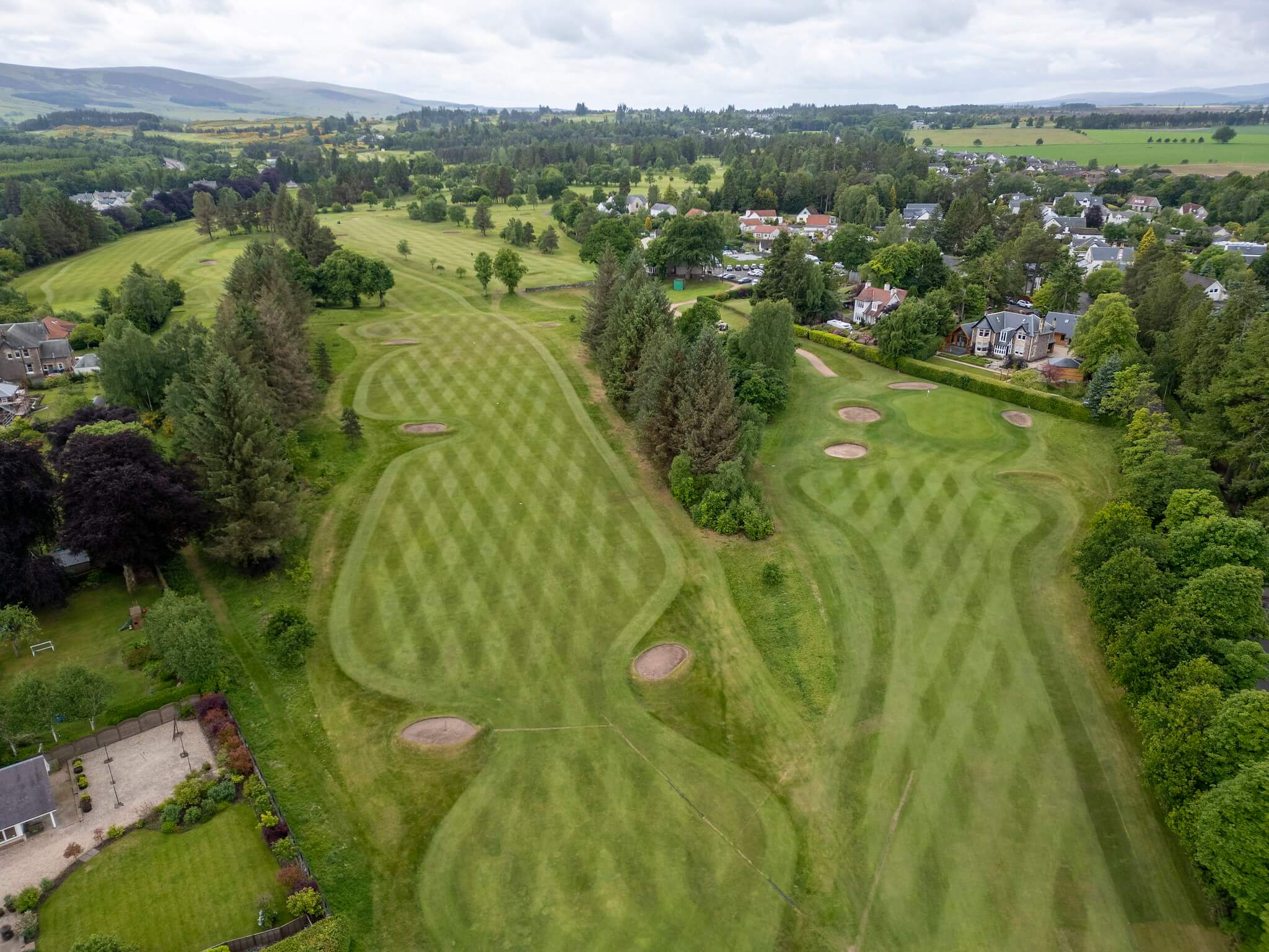
Why courses choose it
- Adds visual movement and depth to the fairway
- Can influence how players perceive angles and landing areas
- Offers a modern, dynamic presentation style
Considerations
- Requires careful route planning and operator awareness
- May increase mowing time depending on layout
Tuxedo cut
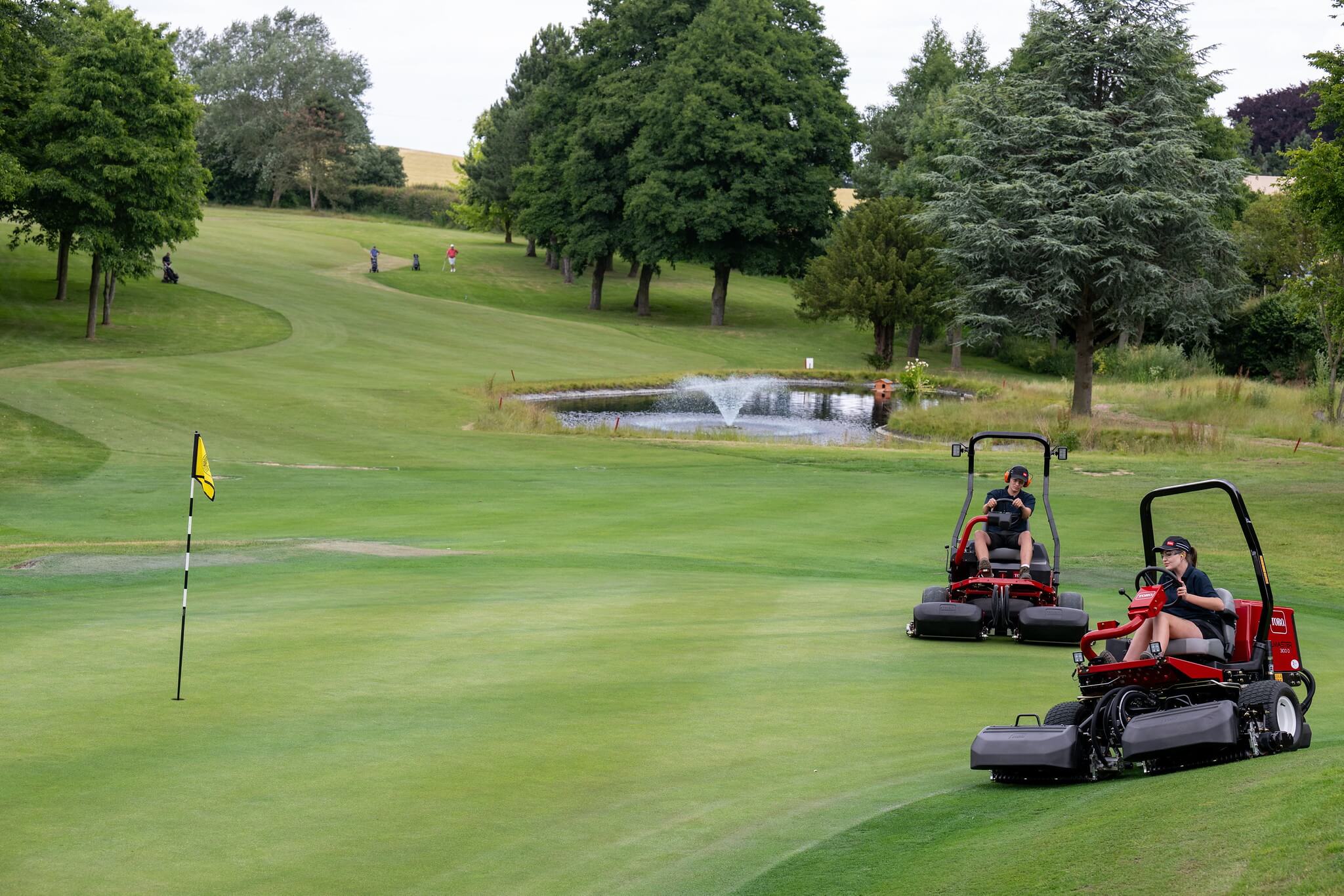
The tuxedo or tux cut is one of the most striking and widely recognised fairway patterns. It features a bold contrast between a lighter central strip and darker outer edges, resembling the clean lines of a formal suit.
Why courses choose it
- Creates a premium, championship-level appearance
- Clearly defines fairway boundaries
- Enhances visual impact from tee to green
Considerations
- Requires careful planning and consistent execution
- May take longer to maintain across multiple holes
Circle or spiral mowing
Circular or spiral mowing takes a more organic approach, following the natural shape and contours of the fairway rather than imposing straight lines.

Why courses choose it
- Creates a more natural, flowing aesthetic
- Enhances the visual connection between fairway and surrounding landscape
- Works well on undulating or uniquely shaped holes
Considerations
- Requires strong route planning and operator awareness
- Can be more time-intensive depending on layout
More than aesthetics: practical considerations
Although mowing patterns often have a striking visual impact, they are never purely cosmetic. Every pattern choice involves practical trade-offs.
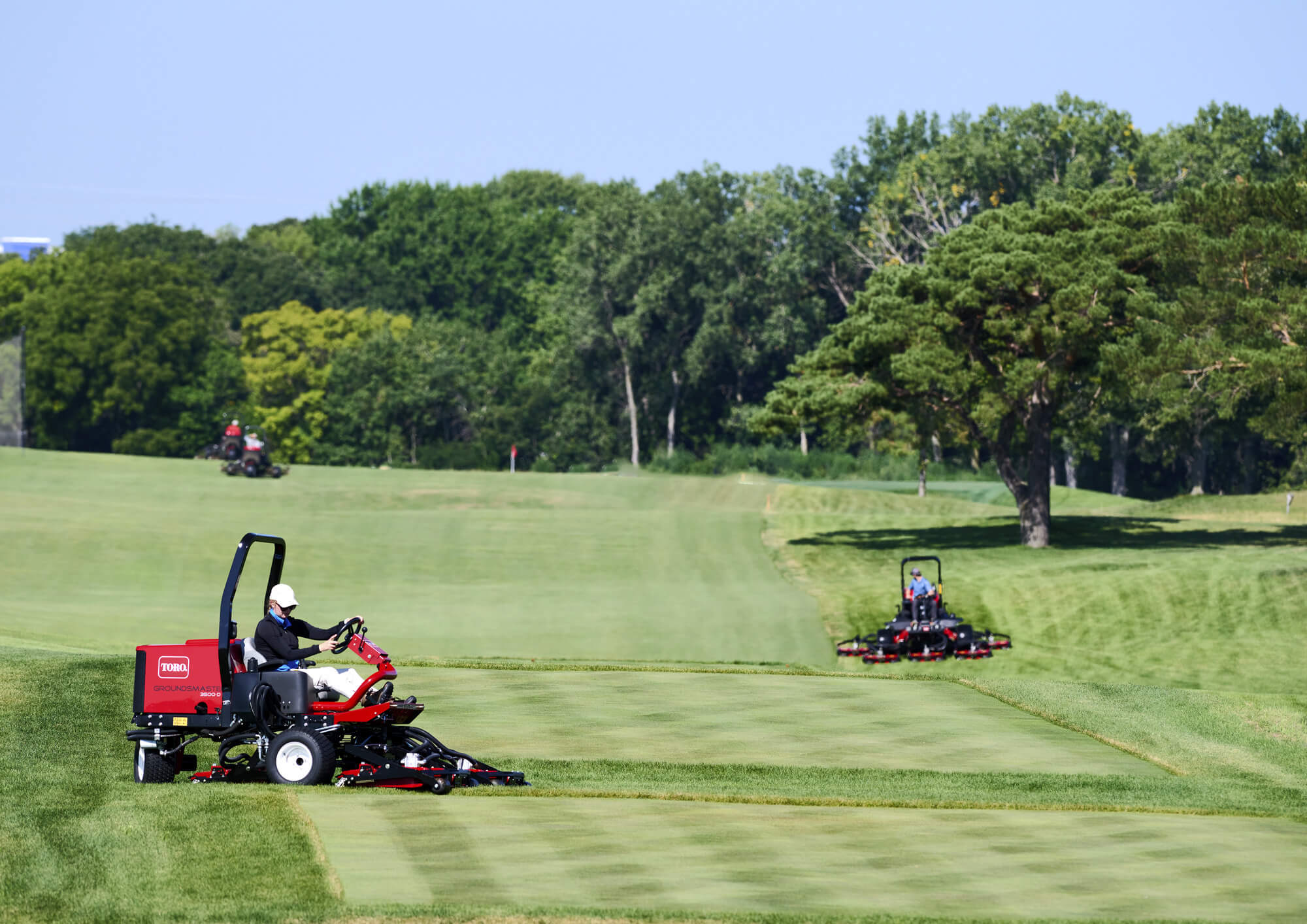
Time and labour
Some patterns are quicker to execute and easier to repeat consistently. Others require more planning, more passes or greater operator skill.
For instance, research from the USGA Green Section highlighted how pattern choice can directly affect efficiency: comparing striped and half and half mowing patterns, it was found that 50/50 patterns are generally faster to deliver, particularly across larger fairway areas.
Efficiency of operation
Route planning, turning points and machine setup all influence how efficiently a pattern can be delivered. Indeed, more complex designs can increase the time required for the task.
The same USGA Green Section study discovered that switching to more efficient mowing patterns, like a half and half over a striped cut, can reduce time per acre by around 13.5%, while also lowering fuel use and machine wear.
Over time, this can make a meaningful difference to labour allocation, maintenance schedules and overall operating costs.

Turf health
Repeatedly mowing in the same direction can lead to grain, compaction or uneven wear. Varying patterns helps maintain healthier, more resilient turf growth over time.
For many courses, the goal is to strike a balance, achieving a high standard of presentation without compromising efficiency or turf condition.
A brief history of mowing patterns
Fairway fashion has evolved alongside mowing technology. Early fairways were typically cut in simple half and half patterns, largely due to the limitations of horse-drawn gang mowers. As tractor-pulled units became more common, consistency improved, but design options remained limited.

The introduction of modern fairway mowers marked a turning point, allowing operators to create more defined striped patterns. From there, presentation evolved into the more deliberate and expressive approach to mowing patterns we have today.
What modern fairway mowers make possible
The evolution of fairway mowing patterns is closely linked to advances in machinery. The latest Toro fairway mowers, for instance, offer a level of precision and flexibility that was not previously possible.
One of the most significant developments is the ability to cut down to approximately 10 mm, allowing greenkeepers to achieve tighter, more refined fairway presentation.
Modern fairway mowers also support both precision and efficiency, depending on the chosen pattern:
- Wider cutting widths can improve productivity on simpler patterns such as half-and-half.
- Improved manoeuvrability supports more intricate designs like diagonal or diamond-style patterns.
- Contour-following cutting units ensure consistent quality of cut across undulating terrain.
For maintenance staff, this means it is now possible to achieve high-end presentation standards while saving time, budget and labour resources, provided patterns are planned effectively.
Fairway patterns as part of modern course management
Creating patterns when mowing fairways has become an integral part of modern golf course maintenance, determining how a course looks, plays and is perceived.
From classic cuts such as half and half or striping to more complex aesthetic preferences and styles, today’s greenkeeping teams have more options than ever before. At the same time, the underlying principles remain the same: balancing aesthetics with efficiency, and presentation with turf health.

With the capabilities of modern Toro fairway mowers – including lower heights of cut and greater control over finish and manoeuvrability – courses can deliver consistent, high-quality results while maintaining efficient, sustainable operations.
If you’re looking to improve your fairway presentation, speak to a Reesink specialist or call 01480 226800 to explore how Toro fairway mowers can support your approach to precision mowing and course management.